

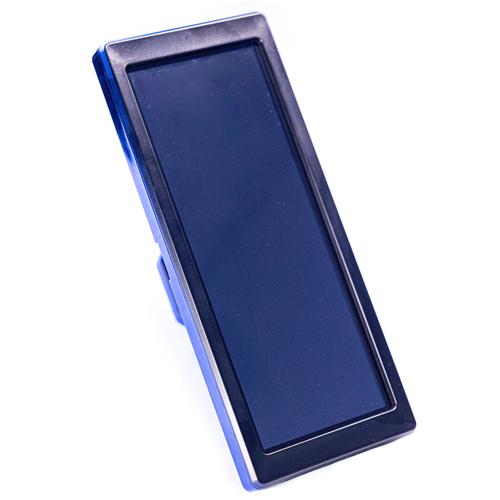
Blind-spot electronic rearview mirrors, also known as indirect vision devices or camera-monitor systems, are an innovative automotive component that not only addresses safety hazards caused by traditional optical mirrors and changing environmental conditions—such as expanding the field of view during acceleration, driving, turning, and reversing, and ensuring clear visibility in rainy or foggy weather and varying light conditions—but also reduces vehicle weight by eliminating exterior rearview mirrors, resulting in energy savings of 2–3% through reduced aerodynamic drag.
Product Features
1. Optional automotive-grade Q100-certified chip design, fast cold start operation, and a frameless, ultra-thin display;
2. Comprehensively addresses the three key blind spots in automotive environments: inherent blind spots, secondary blind spots, and environmental blind spots;
3. Solves the problem of obstacles being invisible to physical glass rearview mirrors in low-light conditions at night;
4. Resolves the issue of poor visibility caused by rain on the surface of glass rearview mirrors, providing a clearer rear view;
5. Glare suppression overcomes the issue of rear vehicle headlights being blinding in glass rearview mirrors at night, making it easier to discern road conditions;
6. Integrates the functions of the vehicle’s left and right exterior rearview mirrors into an ultra-thin, lightweight mirror-style streaming rearview system;
7. Supports control via the vehicle’s original CAN bus signal, enabling adaptive functionality for the combined video feed across different scenarios;
8. Displays a 360-degree panoramic view, automatically switching between long-range and close-up road conditions based on vehicle speed to proactively ensure safety;
9. Combines visual AI recognition technology to effectively identify pedestrians, vehicles, and other animals, providing early warnings of potential hazards around the vehicle;
10. Local video recording is supported, and the system can interface with video signals from the original dashcam to a third-party navigation head unit, ensuring uninterrupted video and enabling remote viewing via the company’s backend;
11. Overcomes the limited field of view of physical glass rearview mirrors; the size and position of the rearview mirror’s field of view can be freely adjusted to suit individual preferences, offering smoother, distortion-free images compared to the double-curvature view of physical
rearview mirrors;
12. The monitor’s brightness automatically adjusts to ambient light conditions and can also be manually adjusted to suit the user’s needs, facilitating easier viewing for the driver. 13. The monitor can be installed in any location within the vehicle, and the viewing angle can be fully adjusted using the mounting bracket.
14. Reduces wind resistance caused by physical rearview mirrors while the vehicle is in motion, thereby saving energy.
| Rearview Mirror/Head Unit Specifications | ||
|---|---|---|
| Parameter Name | Value/Content | Unit |
| Operating voltage | DC 11.8–35 | V |
| Operating current | 910 mA at 24 V | |
| Operating temperature | -35 to 80 | °C |
| Storage temperature | -40 to 105 | °C |
| Software System | LINUX | |
| Screen weight | 0.38 | kg |
| Video Input | 6-channel HD AHD signal | |
| Video Output | Dual 2K | |
| Lens operating voltage | 12 | V |
| Camera resolution | 12.3 inches; 1920×720 mm |
|
| Lens resolution | 1920×1080 | mm |
| Extension cord length | 1–50 (optional) | rice |
| Camera movement | Allows users to adjust as desired | |
| Navigation Compatibility | Supports communication, video recording, and remote access | |
| Image Resizing | Allows users to adjust as desired | |
| Brightness Control | Grading, Manual, Automatic Adjustment | |
| Channel Image Adjustment | Allows users to adjust as desired | |
| Low-light compensation | Support | |
| Anti-glare device | Support | |
| Rearview Mirror/Lens Specifications | ||
|---|---|---|
| Parameter Name | Value/Content | Unit |
| Operating voltage | DC 8–14 | V |
| Operating current | 75 mA at 12 V | |
| Operating temperature | -40 to 80 | °C |
| Storage temperature | -40 to 105 | °C |
| Image sensor | Sony IMX 307 | |
| Standard | PAL | |
| Minimum illuminance | 0.01 | Lux |
| White Balance | Automatic adjustment for night/day | |
| Bright light suppression | Automatic adjustment | |
| Wide Dynamic Range | Support | |
| Horizontal angle | 55/180 | degree |
| Waterproofing Method | Structural Waterproofing | |
| Lens aperture | 2.0 | |
| Gain Control | Automatic | |
| Signal-to-noise ratio | ≥42 dB | dB |
| Optical glass | 7 G | G |
| Lens resolution | AHD 1920×1080 P | |